

Red Light Therapy Brooklyn, NY
- Non-Invasive Light Therapy
- Supports Cellular Recovery
- No Downtime
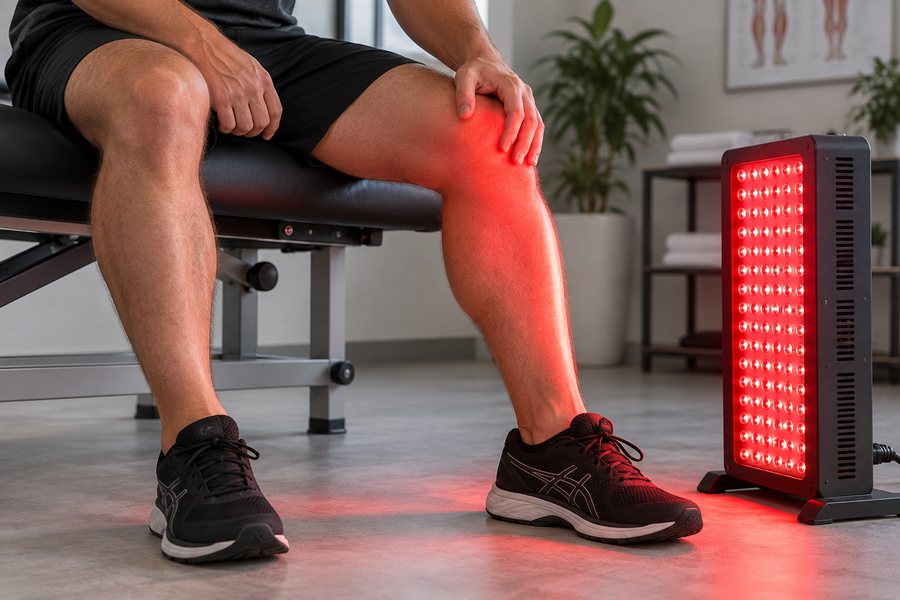
Red light therapy uses low-intensity red and near-infrared light applied to the skin over an area we are working on. I am Dr. Brian Donovan, and at Nuro Chiropractic in Brooklyn it sits in the supportive end of the toolbox rather than the treatment end.
It is comfortable, non-invasive, and there is no downtime. It is also the modality I am most careful not to oversell, because the claims made about it online run far ahead of what it reliably does.
Red Light and Class IV Laser Are Not the Same Thing
This is the confusion worth clearing up first, because both are light-based and patients reasonably assume they are interchangeable.
- Red light uses low-intensity light
- Class IV laser runs at much higher power
- Red light stays comparatively superficial
- Class IV laser reaches deeper tissue
- Red light sessions are longer and repeated
- Class IV sessions are short and targeted
So when the problem is a deeper musculoskeletal one, a tendon, a joint, or chronic pain in a specific structure, Class IV laser therapy is the tool that reaches it. Red light is the gentler, broader option for surface-level support and recovery.
How We Use Red Light Therapy in Brooklyn
- 1 Establish the diagnosis first. Red light is not a diagnosis and it is not the automatic answer for something that hurts.
- 2 Decide whether it has a reasonable role for that particular condition, or whether another treatment is the better use of your visit.
- 3 Position the light source over the target area. You feel gentle warmth at most, and there is nothing to recover from afterwards.
- 4 Track whether it is contributing anything measurable, and drop it from the plan if it is not.
Most often it is used alongside the work that is actually driving your recovery, whether that is chiropractic care, soft-tissue treatment, mobility work, or progressive rehabilitation.
Where It May Help
- Muscle soreness and general recovery between training sessions, which is why active patients ask about it most.
- Superficial soft-tissue discomfort and localized stiffness, as a comfort measure that makes movement easier.
- As an adjunct within a broader plan, when a patient tolerates it well and it appears to help them do the rest of the work.
The research on light-based therapy varies a great deal by condition, and the strongest marketing claims are usually the least supported. I am not going to tell you red light heals injuries, resets your cells, or replaces rehabilitation. If a treatment cannot be justified for your specific diagnosis, we use the visit on something that can.
Who Should Skip It
We avoid treating directly over the eyes, over an area of known or suspected cancer, or over skin that is broken, infected or otherwise compromised. Photosensitivity, whether from a condition or from medication, and pregnancy may require additional precautions depending on the area being treated.
The larger point is the same one that applies to every device in this office. Significant trauma, suspected fracture, infection, progressive neurological loss, or unexplained severe pain needs a proper diagnostic workup. We do not point a light at an undiagnosed problem and call it treatment.
Red Light Therapy FAQs
What is the difference between red light therapy and cold laser?
Power and depth, mainly. Our Class IV therapeutic laser delivers a much higher power output and reaches deeper tissue, which is why it is the one we use for musculoskeletal pain and tendon conditions. Red light is lower intensity and stays more superficial.
Does red light therapy hurt?
No. Most patients feel nothing beyond gentle warmth, and many find it relaxing. There are no needles, no injections, and no recovery period afterwards.
Is it worth buying a device for home use?
Home red light units are widely available and generally safe, which is not the same as saying they will fix a musculoskeletal problem. If you have a specific diagnosis that needs treating, a device you shine on it is not a substitute for addressing why the tissue is irritated in the first place.
How many sessions will I need?
Red light is typically used repeatedly rather than as a one-off, so it usually rides along with visits you are already having. What decides whether we keep using it is whether your symptoms and function are actually moving.
Should I have red light or something else?
That comes out of the examination. For a chronic tendon problem I am more likely to reach for SoftWave. For deeper pain, Class IV laser. For a disc-related problem, decompression. Red light is a supportive option, not usually the reason you came in.
Start With the Diagnosis, Not the Device
If red light therapy has a reasonable role in your case, we will use it and tell you what we expect from it. If something else fits better, I will say so. Our new patient offer covers the consultation, examination, X-rays if needed, and treatment across two visits.
Nuro Chiropractic, 9408 4th Ave, Brooklyn, NY 11209. Serving Bay Ridge, Staten Island, Bensonhurst, Park Slope, Prospect Park, Borough Park, Manhattan, Dyker Heights, Williamsburg, and the greater Brooklyn area.